
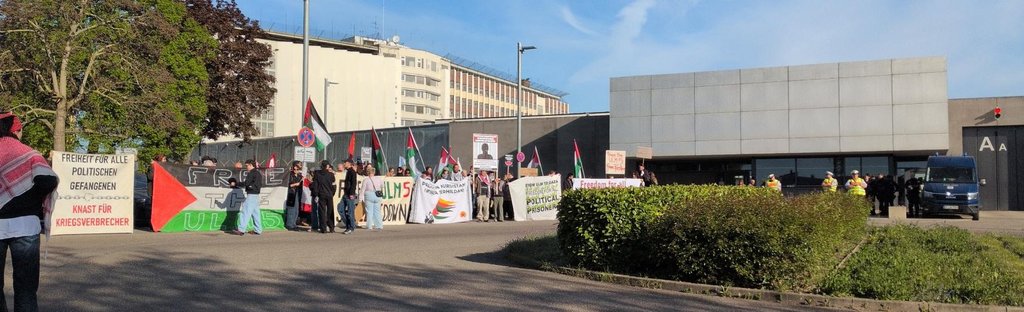
Als Grundrechtekomitee haben wir heute die Eröffnung des Strafprozesses gegen die "Ulm 5" durch das Stuttgarter Landgericht verfolgt. Er findet indes nicht in den Räumen des Landgerichts statt, sondern unüblicherweise im Justizgebäude in Stuttgart-Stammheim. Der Ort dient als Ersatz für das berüchtigte "Mehrzweckgebäude" der Stammheim-Prozesse der 1970er Jahre.
Die Wahl dieses Ortes ist bereits eine Kampfansage, die jedenfalls im Gerichtssaal heute offen ausgetragen wurde.
Denn die fünf Angeklagten befinden sich dort von ihrer Verteidigung sowohl räumlich als auch kommunikativ getrennt. Abgeschirmt vom Geschehen im Saal durch eine hohe Glasscheibe werden sie auf diese Weise selbst zu Zuschauenden ihrer kommenden Verurteilung. Hinter dem Glas können sie sich nur über Mikrofon und Kopfhörer verständigen bzw. der nötigen Verdolmetschung folgen. Das vorgegebene Setting verhindert die vollumfängliche Verfolgung des Prozesses, insbesondere der Verlesung der Anklageschrift sowie die vertrauliche Unterhaltung mit der Verteidigung, eine Verletzung des Rechts auf ein faires Verfahren (Artikel 6 EMRK).
Die Verteidigung forderte daher sofort zu Beginn ein, ihre Mandant*innen zu ihnen in den Saal zu lassen – doch ihre wiederholten Wortmeldungen blieben vergebens: Die Vorsitzende Richterin Lauchstädt gab der Verteidigung nicht das Wort – und die Mikrophone der Verteidigung blieben stumm.
Die herrschaftlichen Gesten des Gerichts waren auch für das Publikum zu spüren: Die Auseinandersetzung zwischen Verteidigung und Vorsitzender Richterin konnte im Zuschauerraum aufgrund der abgeschalteten Mikrofone nicht zufriedenstellend verfolgt werden. Auch waren selbst Stift und Papier dem Publikum verboten und den Pressevertreter*innen wurde die Pressemappe der Verteidigung entzogen, das Justizpersonal sammelte sämtliche Exemplare eigenhändig im Saal vor Prozessbeginn ein.
"Da es in der Vergangenheit auch an diesem Ort, wie wir wissen, durchaus möglich war, die Angeklagten dorthin zuzulassen, wo sie hingehören, nämlich direkt neben ihre Verteidigung – erwarten wir dies nun auch vom Landgericht Stuttgart, und zwar sofort ab dem nächsten Prozesstag, dem 4. Mai 2026. Die räumliche Nähe von Verteidigung und Angeklagten ist landauf, landab überall selbstverständlich und sollte es auch in Stuttgart und für Richterin Lauchstädt sein", kommentiert Britta Rabe, politische Referentin beim Komitee für Grundrechte und Demokratie.
English translation:
Press release: Trial of the ‘Ulm 5’: Presiding judge denies the defendants a fundamental right: proximity to their defence team
As the Fundamental Rights Committee, we followed the opening of the criminal trial against the ‘Ulm 5’ at Stuttgart Regional Court today. However, the trial is not taking place on the court’s premises, but unusually at the courthouse in Stuttgart-Stammheim. The venue serves as a substitute for the notorious “multi-purpose building” used for the Stammheim trials of the 1970s. The choice of this venue is in itself a declaration of war, which was certainly played out openly in the courtroom today.
For the five defendants are separated from their defence team there, both physically and in terms of communication. Shielded from the proceedings in the courtroom by a high glass partition, they thus become spectators of their own impending sentencing. Behind the glass, they can only communicate via microphone and headphones or follow the necessary interpretation. This prescribed setting prevents them from fully following the proceedings, in particular the reading of the indictment, as well as confidential discussions with their defence lawyers – a violation of the right to a fair trial (Article 6 of the ECHR).
The defence therefore demanded right at the start that their clients be allowed into the courtroom with them – yet their repeated requests fell on deaf ears: Presiding Judge Lauchstädt did not grant the defence the floor – and the defence’s microphones remained silent.
The court’s high-handed manner was also felt by the public: the exchange between the defence and the presiding judge could not be followed satisfactorily in the public gallery due to the switched-off microphones. Furthermore, even pen and paper were forbidden to the public, and the press representatives had the defence’s press pack confiscated; court staff collected all copies by hand in the courtroom before the trial began.
“As we know, it has been entirely possible in the past, even in this very courtroom, to allow the defendants to sit where they belong – namely right next to their defence team – and we now expect the Stuttgart Regional Court to do the same, starting immediately from the next day of the trial, 4 May 2026. The physical proximity of the defence and the defendants is taken for granted everywhere across the country and should also be the case in Stuttgart and for Judge Lauchstädt,” comments Britta Rabe, political advisor at the Committee for Fundamental Rights and Democracy.